
Volume 4 Issue 1
PUBLISHED BY: GLOBAL EMERGING PATHOGENS TREATMENT CONSORTIUM (GET)
Authors:
Denloye AA1; Alafia AO2; Ashade AO1; Ajelara KO2; Godonu
KG3; Adetunji BH2; Oke S2; Babaniyi PI2; Ezun SJ2; Ajose RA2
; Oyefolu AOB4
GET Journal of Biosecurity and One Health, Volume 4, Issue 1
Article Keywords: Cockroach; Crude-garlic extract; Antimicrobial activity; Allicin; Staphylococcus; Bacillus; Pseudomonas.
Cockroaches have huge health importance; they may be involved in the passive mechanical transfer of pathogens from humans to animals and food. The study aimed to isolate the external bacterial flora of Periplaneta americana and to determine the antimicrobial activity of crude garlic extract and conventional antibiotics on the bacterial population. A total of 45 Cockroaches (n=45) were collected aseptically from Ojo
and Iyana-era all in the Ojo local government area of Lagos State, Nigeria. Bacteria were isolated on nutrient agar, MacConkey agar, and Salmonella-Shigella Agar and were putatively identified based on cultural, morphological, and biochemical characteristics. The identification system was complemented with an Analytical Profile Index (API). A total of 30 bacterial strains were identified, of which 23 were Gram- positive, and 7 were Gram-negative, belonging to the Pseudomonas, Bacillus, Streptococcus, Escherichia, Staphylococcus, Actinomycetes, Enterococcus, Serratia, and Listeria genera. The antimicrobial activities of garlic extract on isolates revealed that strain OJ9, IE4, OJ8, and OJ3 had inhibition zone values of 26.5 ± 2.1, 26.0 ± 1.4, 24.5 ± 2.1, and 24. ± 1.4. A high inhibition zone was also obtained with strains OJ5, OJ10, and OJ4, respectively, whereas OJ1, OJ2, and OJ12 did not show inhibition zones. The antibiotic susceptibility and resistance patterns showed that Strain OJ1 was susceptible to ciprofloxacin but resistant to gentamycin and zinnacef, whereas OJ7 was susceptible to erythromycin and perfloxacin but resistant to
other antibiotics, including. Also, strain IE7 was susceptible to perfloxacin, rocephin, and septrin. The study provided clear insight into the antimicrobial potency of the Allium sativum crude extract.
Authors: Adebayo FO1* and Fagbohun ED2
1Global Emerging Pathogens Treatment Consortium (GET)
2Department of Microbiology, Ekiti State University, Ado-Ekiti, Ekiti State,
Nigeria
GET Journal of Biosecurity and One Health, Volume 4, Issue 1
Article Keywords: Pigeon pea; Cajanus cajan; Storage effects; Proximate composition; Mineral composition; Mycoflora
This study investigates the impact of a twenty-week storage period on the proximate composition, mineral content, and mycoflora of sun-dried pigeon pea (Cajanus cajan) seeds. The storage conditions were observed to promote fungal contamination, leading to qualitative and quantitative changes in the seeds’
nutritional and mineral composition. Fungal species isolated included Aspergillus niger, A. fumigatus, A. flavus, A. oryzae, Fusarium oxysporum, F. solani, F. moniliforme, Rhizopus stolonifer, Alternaria alternata, and Penicillium notatum. Proximate analysis (g/100g) showed significant increases in moisture content (9.86 to 13.13), ash (2.60 to 3.15), fat (1.25 to 3.17), and carbohydrate (0.22 to 10.56). However, fiber (7.75 to 4.61) and crude protein (76.74 to 68.83) content decreased, suggesting deterioration in the seeds’ quality over time. Mineral analysis revealed reductions in sodium (3.49 to 2.47), potassium (21.26 to 15.03), calcium (6.02 to 3.43), magnesium (11.75 to 9.27), zinc (0.09 to 0.05), iron (0.28 to 0.21), copper (0.07 to 0.02), manganese (0.08 to 0.05), and phosphorus (19.02 to 12.03). The findings indicate that prolonged storage at room temperature facilitates mycoflora proliferation, leading to degradation in nutritional and mineral composition. This has significant implications for food security, as pigeon pea is a key protein source in many regions. The study underscores the importance of adopting improved storage techniques to minimize fungal contamination and nutrient loss, thereby enhancing the economic and nutritional value of stored pigeon pea seeds.
Authors:
1Obro KA, 2Kintossou KA, 3N’Dri KM, 1Konan KM, 1Adon A, 1Dosso M
1Cell Biology Unit, Institut Pasteur de Côte d’Ivoire
2Biobank, Institut Pasteur de Côte d’Ivoire
3Department of Epidemiology and Clinical Research, Institut Pasteur de Côte
d’Ivoire
*Corresponding Author: OBRO Koby Albert
GET Journal of Biosecurity and One Health, Volume 4, Issue 1.
Article Keywords: Knowledge; Biobank; Amniotic Membrane; Health Professional; Ivory Coast.
The amniotic membrane is a thin membrane located on the inside of the placenta. It is widely used to treat several conditions. Its therapeutic value in the biomedical field requires the creation of a biological database. The creation of this bank requires the participation of healthcare staff. This study aimed to assess the knowledge of healthcare professionals about the biobank and the conservation of amniotic membrane for use in research and therapy in Côte d’Ivoire. A cross-sectional survey was conducted among healthcare professionals. The survey included questions on participants’ professional profiles, their knowledge of the biobank, its role and activities, and the use of amniotic membrane tissue in research and therapy. A total of 215 people took part in the survey, 64.2% of whom said they had never heard of a biobank before. Only 35.3% of participants were aware of the role and activities of a biobank. Regarding the storage of amniotic membrane in a biobank for diagnosis, treatment, and research, only 32.1% of respondents were aware of this. Bivariate analysis showed that function (intern: OR=1.11; 95% CI [0.26- 4.35], midwife: OR=16.2; 95% CI [6.71-45.8], trainee: OR=19.4; 95% CI [4.55 109], and length of professional experience (1 5: OR=2.01; 95% CI [1.09- 3.82], “< 1 year”: OR=12.4; 95% CI [2.41- 227],) were associated with knowledge of amniotic membrane preservation and its use for research and therapy. The healthcare professionals surveyed had limited knowledge of biobanks in general and amniotic membrane preservation in particular. However, the majority had a positive attitude towards amniotic membrane donation for research and therapeutic purposes.
Authors: Hassan AY1 *; Lawal MD2 and Usman M2
1 Department of Veterinary Medicine, Faculty of Veterinary Medicine, Usmanu Danfodiyo University, Sokoto.
2Department of Veterinary Parasitology and Entomology, Usmanu Danfodiyo University, Sokoto.
*Corresponding Author: Abubakar Yahaya Hassan
GET Journal of Biosecurity and One Health, Volume 4, Issue 1.
Article Keywords: Ectoparasites; Rhipicephalus sanguineus; Prevalence; Cats; Sokoto State; Nigeria..
Ectoparasites are a significant cat health concern, particularly in regions with varying environmental and management conditions. This study assessed the prevalence and distribution of ectoparasites in domestic and stray cats in Sokoto State, Nigeria, with a focus on Rhipicephalus sanguineus, the brown dog tick. A cross-sectional study was conducted examining 30 cats, comprising 15 domestic and 15 strays. The presence of ectoparasites was determined through visual inspection and identification. The study identified Rhipicephalus sanguineus as the sole ectoparasite, with an overall prevalence of 13.3%. All infestations occurred in stray cats (26.7%), while no ectoparasites were found in domestic cats. The prevalence was significantly higher in females (25.0%) than in males (0.0%), and in adults (21.05%) than in juveniles (0.0%). The findings highlight a notable disparity in ectoparasite prevalence between domestic and stray cats in Sokoto State. The higher prevalence among stray cats, particularly females and adults, underscores the need for targeted control measures and public education to effectively manage ectoparasite infestations.
Authors:
*1,2Babagana-Kyari M, 3,4Yaro NA, 4Kabiru MY
1Department of Environmental Health and Safety, School of Health Sciences, Maryam Abacha American University, Maradi, Niger
2Centre for Environmental and Geographical Research, Yobe State
University, Damaturu, Yobe State, Nigeria
3Department of Geography, Northwest University, Kano, Nigeria
4School of Public Health, Maryam Abacha American University of Nigeria,
Kano
*Corresponding Author: Modibbo Babagana-Kyari
Phone: +2348030502141
GET Journal of Biosecurity and One Health, Volume 4, Issue 1.
Article Keywords: Tessellation; Disease mapping; CKDu; Spatial prevalence; Qfield survey; Bade CKD.
Chronic Kidney Disease of unknown etiology (CKDu) poses a major public health challenge in Northern Yobe State, Nigeria, particularly in settings characterized by limited geocoded health records and weak disease surveillance systems. In such data-poor contexts, alternative methodological approaches are required to understand disease distribution and guide etiological investigations. This study demonstrates how CKDu spatial prevalence can be examined using a community-centric, GIS-based approach that relies on surveys of diagnosed CKD cases within victim households in a CKDu-endemic region of Yobe, integrating participatory data collection with open-source geospatial tools. Household-level data were collected through electronically administered questionnaires deployed via the KoboToolbox platform, supported by community leaders and implemented through snowball sampling over a 28-day period. Spatial
analyses, including hexagonal grid-based tessellation, hotspot mapping, kernel density analysis, and spatial autocorrelation, were employed to visualize and quantify disease clustering. CKD incidence counts were aggregated within a uniform hexagonal grid, and spatial variability was classified using standard deviation–based incidence density categories to identify statistically meaningful concentration patterns across the study area. The analysis identified three distinct hotspots categorized by disease incidence density levels: high (7–10 cases), medium (3–6 cases), and low (1–2 cases). Spatial statistics derived from Moran’s I index yielded a value of 0.1046, with a z-score of 4.95 and a p-value of 0.000001, indicating a less than 1% probability that the observed clustering of CKD incidences occurred randomly. Overall, the findings demonstrate that CKDu occurrence in Northern Yobe State is spatially non-random and can be effectively characterized through GIS-based, community-centric approaches in data constrained regions. Thus, by generating spatially explicit evidence from diagnosed household cases, this methodology provides a robust foundation for targeted exploration of environmental risk factors and supports informed public health surveillance, environmental management, and policy interventions aimed at uncovering the aetiology
of heightened CKDu prevalence in Northern Nigeria.

Recent Journal Articles
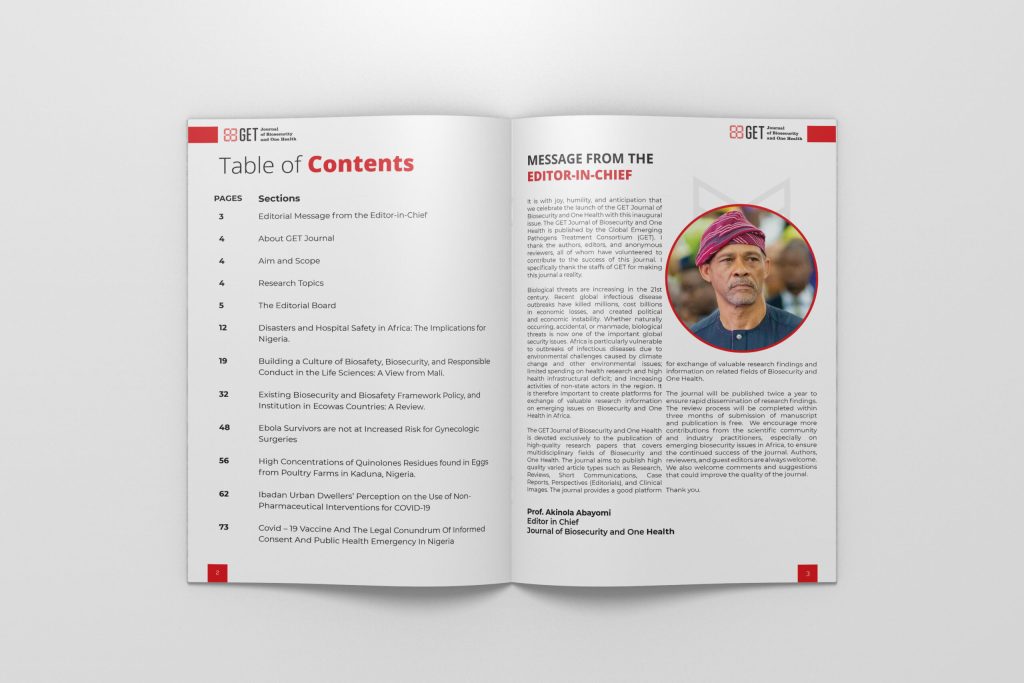
- Ebola Survivors are not at risk for Gynecological Surgeries
- Existing Biosecurity and Biosafety Frameworks, Policies and Institutions in ECOWAS Countries: A Review
- Building a Culture of Biosafety, Biosecurity and Responsible Conduct in the Life Science: A View from Mali
- Disasters and Hospital Safety In Nigeria.
- High Concentrations of Quinolones Residues found in Eggs from Poultry Farms in Kaduna, Nigeria.
- Ibadan Urban Dwellers’ Perception on the Use of Non-Pharmaceutical Interventions for COVID-19.
- COVID-19 Vaccine and the Legal Conundrum of Informed Consent and Public Health Emergency in Nigeria.